 Ammunition Boxes
 Apparel Boxes
 Automotive Boxes
 Candle Boxes
 CBD Boxes
 Cosmetic Boxes
 Electronics Boxes
 Food Boxes
 Gift Boxes
 Pharmaceutical Boxes
 Retail Boxes
 Soap Boxes
 Straight Tuck End Boxes
 Reverse Tuck End Boxes
 Magnetic Closure Boxes
 Two Piece Boxes
 Shoulder Neck Boxes
 Rigid Drawer Boxes
 Book Style Rigid Boxes
 Collapsible Rigid Boxes
 Tuck Top Boxes
 Display Boxes
 Gable Boxes
 Mailer Boxes
 Autolock Bottom Boxes
 Telescopic Boxes
 Seal End Boxes
 Christmas Gift Bags
 Cosmetic Paper Bags
 Grocery Bags
 Kraft Paper Bags
 Merchandise Bags
 Mylar Bags
 Retail Bags
 Advent Calendar Boxes
 Bookmarks
 Bottle Neckers
 CD Jackets
 Door Hangers
 Ice Cream Cups
 Table Tents
 Tags Printing
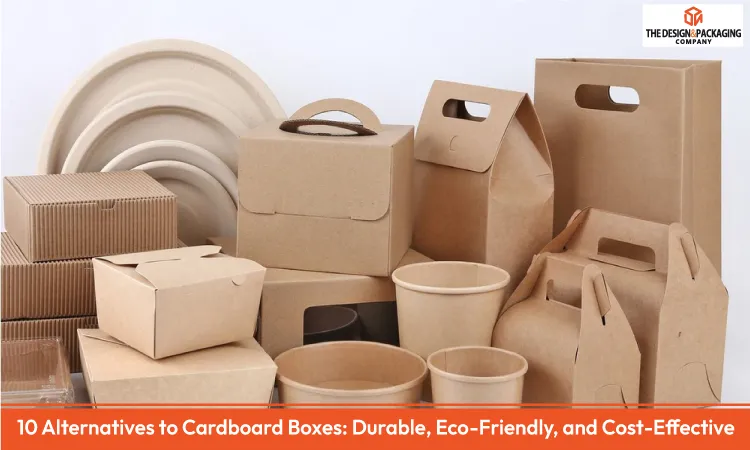
Cardboard boxes are one of the most widely used packaging solutions because they are affordable, easy to store, and suitable for many shipping applications. They aren’t always the choice. Businesses often look for alternatives that reduce shipping costs, improve sustainability, provide better product protection, or support specialized needs.
The alternatives below offer different advantages depending on the product, shipping environment, and customer expectations.
- 1. Vacuum‑Sealed Bags
- 2. Molded Pulp Packaging
- 3. Paperboard Boxes
- 4. Compostable Mailers
- 5. Mushroom Packaging
- 6. Seaweed‑Based Packaging
- 7. Cornstarch Packaging
- 8. Corrugated Bubble Wrap
- 9. Reusable Bags
- 10. Shrink Wraps
- How Should Manufacturers Choose the Right Cardboard Alternative?
- Which Cardboard Alternative Fits Common Packaging Requirements?
- How to Choose the Right Cardboard Alternative?
1. Vacuum‑Sealed Bags
By reducing unused air in parcels, vacuum-sealed bags can cut freight costs. Compress a sweatshirt, and it goes from box-sized to envelope-sized. That is a real cost reduction, not a marginal one.
The limit is obvious once you say it out loud: there is no rigid shell. Anything with corners, edges, or fragile surfaces will not survive on film alone. Think of vacuum bags as a compression tool, not a protective one. Use them for soft goods, check your carrier’s dimensional-weight thresholds to confirm the savings hold, and if the product still needs some structural protection, a lightweight outer case gives you both.
2. Molded Pulp Packaging
In most fulfillment centers shipping small electronics, molded pulp dominates pick zones. It isn’t there because someone ran a sustainability audit. It is there because it works: the product sits in the cavity, doesn’t shift, and arrives intact. That is the whole pitch.
The part that catches people off guard is the tooling commitment. A 5mm change to a bottle shoulder, the kind of thing that happens quietly during a product refresh, can void an entire run of inserts. One cosmetics team found this out when a mold ordered six months earlier no longer matched the updated bottle geometry. New mold, new lead time, cost absorbed. For stable product lines, that commitment is fine. For anything that iterates frequently, it is worth pricing in before signing off on tooling.
One more thing to check before rollout: humidity. In drier climates and controlled storage, molded pulp performs reliably. In warm, humid receiving areas or coastal distribution hubs, some uncoated grades soften enough to lose cavity retention. Worth asking your supplier which conditions their format is validated for.
3. Paperboard Boxes
Paperboard boxes are a common choice for products that need attractive shelf presentation rather than heavy-duty shipping protection.
Cosmetics, supplements, and personal care products are a natural fit. High-resolution print, compact footprint, clean barcode readability, and paperboard are hard to beat on cost per unit at volume for these applications.
Its limitations become apparent when structural strength is required. Stack it under a pallet load, and it buckles.
That failure mode is predictable, avoidable, and still surprisingly common when the format gets specified for a product that needs real structural strength. Avoid it for heavy products, glass, or shipments facing rough handling. An outer shipping carton may still be needed when sending products directly to customers.
4. Compostable Mailers
To reduce plastic without raising shipping costs, many apparel brands switched to compostable mailers. T-shirts, leggings, and lightweight accessories are typically good candidates because they don’t require rigid protection.
Problems usually appear when businesses push mailers beyond their intended use. Products with sharp edges can puncture the material, while fragile goods remain vulnerable to crushing during transit.
The environmental story also depends on disposal access. A compostable mailer provides far less benefit when customers have no practical way to compost it after delivery.
5. Mushroom Packaging
Mushroom-based packaging earns its reputation on premium electronics and glass products. The cushioning can rival traditional foam when the cavity is designed precisely around the product. That precision is also the format’s most common source of failure: a cavity that is even slightly oversized transfers impact rather than absorbing it, the opposite of how foam behaves with a loose fit. Production speed is the other practical constraint.
Frequent product redesigns require new molds each time, adding lead time that corrugated or cut-foam alternatives don’t carry. Real-world drop testing before scaling isn’t optional, as it is how brands find out whether performance holds at the actual product mass and center of gravity, not against a dimensional drawing.
6. Seaweed‑Based Packaging
For brands focused on renewable materials and short product life cycles, seaweed-based solutions are an emerging option. They are most commonly used for food items, single-use applications, and products that move quickly through the supply chain.
Fresh food kits and short-shelf-life consumer goods are the most practical use cases today. Long storage periods, fluctuating humidity, or complex distribution networks can expose performance limitations.
Seaweed-based materials are still developing as a category, so availability and performance can vary significantly between suppliers.
7. Cornstarch Packaging
A warehouse in a humid climate runs cornstarch loose fill through summer. Nobody flags it because nothing looks wrong. Then a damage claim comes in, someone checks the fill, and it has been softening for weeks. The starch matrix doesn’t fail visibly; it quietly stops doing its job.
In controlled environments, cornstarch is genuinely useful. Loose fill, padded trays, and form-fit pads for light to moderate impacts, as it handles all of those well. Keep an eye on storage conditions, run periodic compression checks in warmer months, and confirm that any composting claim on the label matches what customers can access near them.
8. Corrugated Bubble Wrap
Corrugated bubble wrap combines paper-based materials with cushioning performance, making it a useful option for protecting surfaces during shipping and storage.
A framed print may survive shipping without scratches thanks to corrugated bubble wrap, but don’t expect it to absorb the impact of a warehouse drop. Its primary job is preventing surface damage, not replacing structural packaging. Typical paper‑bubble laminates are offered in various thicknesses; for example, they are available in multiple constructions. Thickness and cushioning performance vary widely by supplier, liner weight, and flute design.
Heavy products and items exposed to drop risks generally require a rigid outer container in addition to corrugated bubble wrap. Pair it with a rigid outer carton or crate when products must withstand drops or stacking loads.
9. Reusable Bags
Reusable bag programs look better in sustainability decks. They look less appealing six months in, when return rates have dropped, and the per-unit cost of a bag that ships once is three times what a single-use option would have cost. The model works when you own the return loop, grocery delivery, meal kits, subscription boxes, where the driver picks up last week’s bag on the next visit. It doesn’t work when you are hoping customers will mail something back.
If the logistics are genuinely closed-loop, the material holds up well. Seam strength matters more than it seems for heavier loads, worth testing at actual route weights before rollout. And have a plan for worn bags before the program starts, not after the first batch comes back unusable.
10. Shrink Wraps
Shrink wrap is widely used for bundling products and stabilizing pallet loads during transportation. It helps secure items, reduce shifting, and provide basic protection against dust and moisture.
Shrink wrap works well for keeping palletized goods such as bottled water or canned products stable during transport. Wraps don’t provide cushioning. If a package is dropped, shrink wrap alone will not prevent damage. For sensitive products, it should always be paired with protective packaging materials that provide impact resistance during transit.
In packaging selection, ‘compostable’ should specify home or industrial composting; ‘recyclable’ should specify accepted material stream; and ‘protective’ should be validated by drop, compression, puncture, or vibration testing for the SKU.
The table below summarizes the ten categories and aligns with the selection criteria that manufacturing engineers apply for fragile goods, moisture‑sensitive items, or tight freight budgets.
| Alternative | Used For | Main Benefit | Main Drawback |
|---|---|---|---|
| Vacuum-Sealed Bags | Clothing, bedding, and other compressible goods | Reduces package size and shipping costs | Provides little to no impact protection |
| Molded Pulp Packaging | Bottles, jars, and fragile electronics | Strong product-specific protection | High tooling costs for custom molds |
| Paperboard Boxes | Cosmetics, supplements, and retail products | Branding and print quality | Limited stacking and load-bearing strength |
| Compostable Mailers | Apparel, documents, and soft goods | Lightweight and environmentally friendly | Requires access to suitable composting facilities |
| Mushroom Packaging | Fragile, high-value products | Custom-fit cushioning with sustainability appeal | Longer production times and higher costs |
| Seaweed-Based Packaging | Short-life food and cosmetic products | Lightweight and renewable material | Limited durability in humid or long-term storage conditions |
| Cornstarch Packaging | Loose-fill and light cushioning applications | Compostable cushioning solution | Sensitive to moisture and humidity |
| Corrugated Bubble Wrap | Framed art, glass, and surface-sensitive items | Good surface protection and recyclability potential | Doesn’t provide structural support |
| Reusable Bags | Closed-loop delivery and return programs | Reduces single-use waste | Requires an effective return system |
| Shrink Wraps | Pallet loads and multipack products | Load stabilization | Offers no cushioning or impact protection |
Use the table as a quick comparison tool. Start by identifying your product’s main requirement as protection, lower shipping costs, sustainability, or retail presentation, then compare the alternatives that match those priorities. For many businesses, this table can narrow the options to two or three formats before testing begins. Example: For high-SKU assortments, validate two shortlisted formats with drop and compression tests before locking tooling.
For example, apparel brands may focus on vacuum-sealed bags or compostable mailers, while businesses shipping fragile products may prefer molded pulp, mushroom boxes, or cushioning materials. The table helps narrow the options before investing in trials, custom tooling, or large purchasing commitments.
How Should Manufacturers Choose the Right Cardboard Alternative?
Manufacturers should begin by identifying the primary packaging requirement, whether it is reducing shipping costs, protecting fragile items, improving sustainability, enhancing retail presentation, or supporting efficient storage and transportation. The most suitable cardboard alternative is the one that best meets these functional requirements while balancing product protection, logistics, environmental impact, and overall packaging costs.
Which Cardboard Alternative Fits Common Packaging Requirements?
The most appropriate cardboard alternative depends on the functional requirements of the packaging application. Molded pulp is well suited for products that require custom-shaped protection, paperboard works best for retail packaging with high-quality printing and branding, compostable mailers are ideal for lightweight and flexible goods, reusable bags support closed-loop delivery systems, and shrink wrap is primarily used for pallet stabilization and load security rather than individual product packaging.
How to Choose the Right Cardboard Alternative?
The right cardboard alternative is the one that delivers the best balance of product protection, shipping efficiency, environmental impact, and overall cost for the intended packaging application, not the one with the strongest sustainability claims. Avoid replacing corrugated boxes simply because an alternative appears greener or lighter. For heavy items, long-term storage, or palletized shipments, corrugated packaging often remains the safest and most reliable baseline. A cardboard alternative should be selected only when it provides measurable improvements in dimensional weight, cushioning, moisture resistance, returnability, or end-of-life disposal and recycling.